 Hands On AI
Case study · Remodeling & repair
A website he can change from the truck.
Rock Royalty is an owner-operated remodeling, repair, and finish-carpentry business working across Garfield County. The old site was a rented builder package that came bundled with an email subscription. The new one is his.
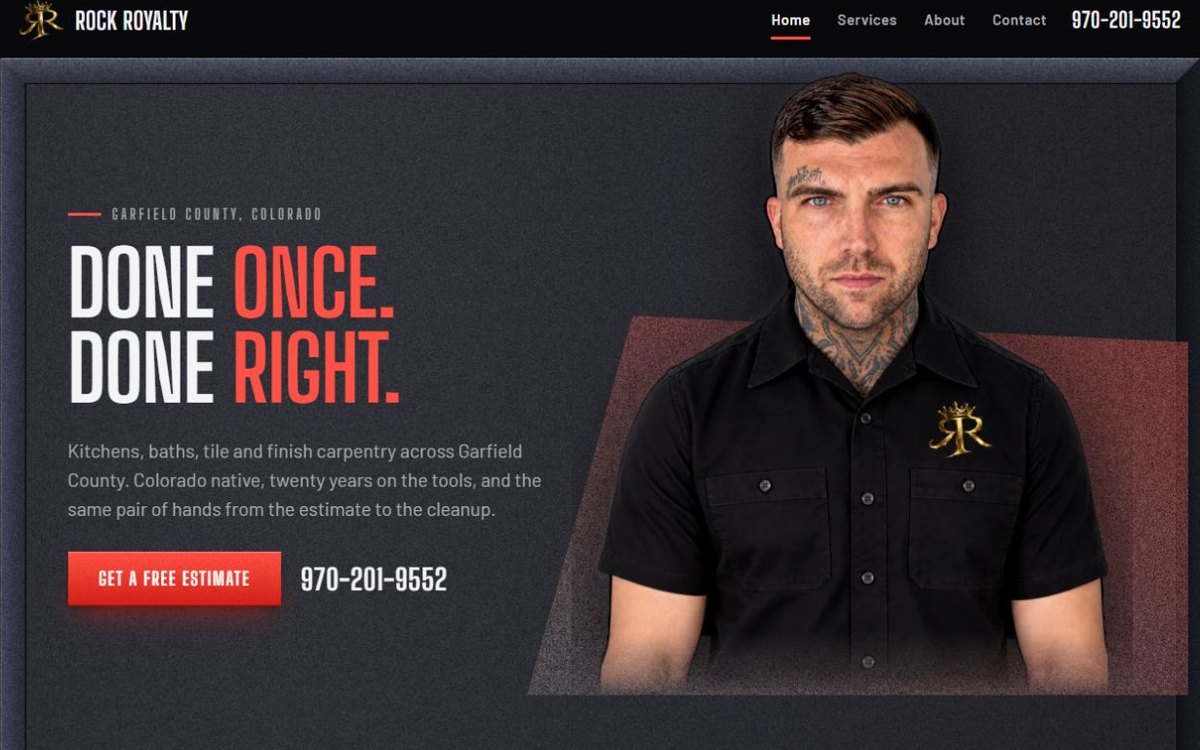
- BusinessOwner-operated remodeling, repair and finish carpentry
- WhereParachute, Colorado — serving all of Garfield County
- LaunchedSeptember 2026
- Built withCloudflare Workers, D1, and KV — in the client's own account
- ReplacedA GoDaddy Websites + Marketing subscription
- Live atrockroyaltylimited.com
What the business needed
A one-man shop has a specific website problem. The work is visual, so photographs matter more than words. The jobs change, so the list of services drifts. And there is nobody in the office to update anything, because there is no office and no one else.
The existing site sat inside a rented website builder, alongside a separate paid email subscription for the business address. Both were monthly costs for things he had stopped being able to shape. The goal was a site that looked like the quality of the work, kept the same web address so nothing already in circulation broke, and could be changed by one person with a phone and five minutes.
Everything in his name, from the first day
The decision that shaped the rest of the project was made before any design work started: the site would live in the client's own hosting account, not in mine with a promise to move it later.
That sounds like a formality. It is not. Hosting resources of this kind generally cannot be moved between accounts after the fact—transferring them means rebuilding them. Starting in the right account is the difference between a handover and a second project.
The same reasoning ran through everything else. The deploy tooling was written to refuse to run if it detected credentials pointing at my account rather than his, because the failure mode it guards against is silent and expensive. The domain stayed with his registrar. Inbound email was switched to forward to his personal inbox at handover, so nothing addressed to his business lands with me.
- Hosting account: the client's, created before any deployment
- Domain: unchanged, at his own registrar
- Business email: forwards to his inbox, not through mine
- Source code: his, with the full history
- My access: removable at any time, with nothing breaking when it goes
The DNS migration, done carefully
Moving a working domain is the step where real damage happens, so it was done as a like-for-like replica first: every existing DNS record copied across and verified one to one before anything was switched, with nothing corrected in the same motion.
That last part was deliberate. The audit turned up pre-existing mail-authentication problems that had nothing to do with the new website—records that authorised the wrong servers to send his mail. Fixing those during the cutover would have meant that if anything broke, there would be no way to know which change caused it. They were documented and handled separately, on a separate day.
An admin with three things in it
The custom admin does exactly three jobs: contact details, photographs, and services. That is not a first version with more planned. It is the whole design.
Contact details—phone, email, hours, the towns he covers—change in one place and update everywhere on the site at once. Photographs can be swapped for any slot on the site, with a description field, because the description is part of how search engines understand the work. Services can be reworded, reordered, and rewritten.
What the admin deliberately cannot do is break the site. There is no way to delete a page, no layout editor, no rich-text field that can swallow the design. The constraint is the feature: a tool you cannot ruin is a tool you will actually use.
There is also a read-only view of everything submitted through the contact form, which exists as a backstop. Enquiry emails can go astray; a record that does not depend on email delivery means a lost message is recoverable rather than gone.
Two copy decisions worth naming
The site says "I", never "we". He is one man, and the pitch is precisely that you deal with him from the estimate through the cleanup. A one-man business writing like a firm gives away the only thing that makes it different.
Second: the word "handyman" appears in the page titles, the meta descriptions, the structured data, the image descriptions and one FAQ answer—and in no headline anywhere on the site. It is the word people type into Google. It is not the positioning of a business doing tile showers and finish carpentry. Both of those things can be true at once, and the site is built so they are.
There are also two claims the site does not make anywhere: licensed and insured. He holds neither, Colorado licenses some trades at state level, and a convenient sentence on a website is not worth the exposure. Leaving it out was a decision, not an oversight.
The design
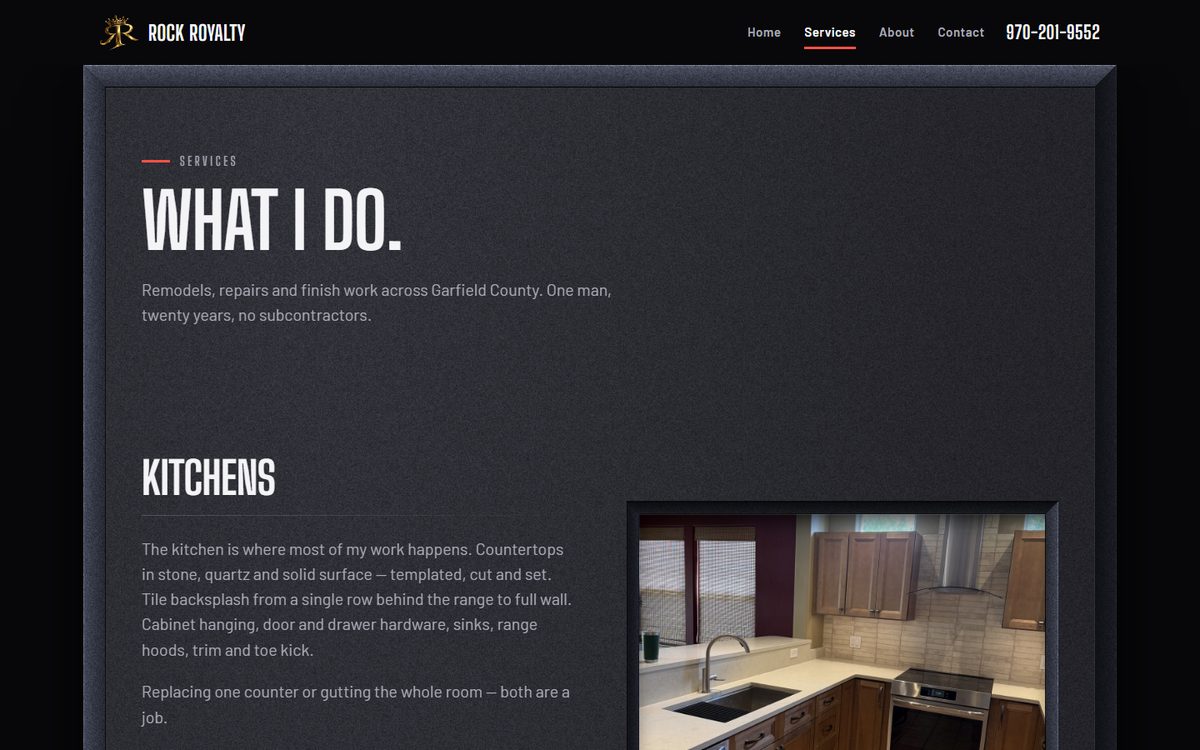
The whole visual system is three material planes under a single light source from above. Photographs are cut down into the surface, so their top edge is dark and their bottom edge catches the light. Panels rest on top of it, lit along the top and shadowed below.
Inset and raised are the same recipe inverted, and that inversion is what makes the page read as one material rather than two unrelated effects. Two shared angle values are reused throughout and dropped entirely on narrow screens, where the tilt stops helping and starts costing space.
The glass panels are gradient and edge work rather than real blur. Blur appears exactly once, on the navigation, so that scrolling stays smooth on a mid-range phone—which is what most of his customers are holding.
What he was left with
A launch is not finished when the site goes live. The handover document was written in plain English and covers what he owns, what each account is for, what to cancel at his old provider and—importantly—what to save before cancelling it, since ending a mailbox subscription deletes the mail inside it.
It also covers the things a website cannot do for him. A Google Business Profile matters more than the site does for "handyman near me" searches, because the map appears above the web results. Two phone numbers circulating for one business makes him harder to find, not easier. None of that is billable work. All of it is the difference between a website and a business that gets called.
Where the AI maintenance orientation fits
Honestly: this project predates it. Rock Royalty was handed over with a custom admin, which covers the changes he actually makes—hours, photographs, services—without needing any AI workflow at all.
That is worth saying plainly, because the two approaches solve the same problem at different levels. An admin is the better answer when the changes are predictable and the owner wants a button. The AI maintenance handoff is the better answer when the changes are not predictable, and it is now offered as part of every website project. Some businesses will want both.
Your own version of this
Most of it transfers.
Different trade, different town, same shape: a site that looks like the standard of your work, accounts in your name, and a way to keep it current that does not route through somebody else's inbox.
Start a conversation